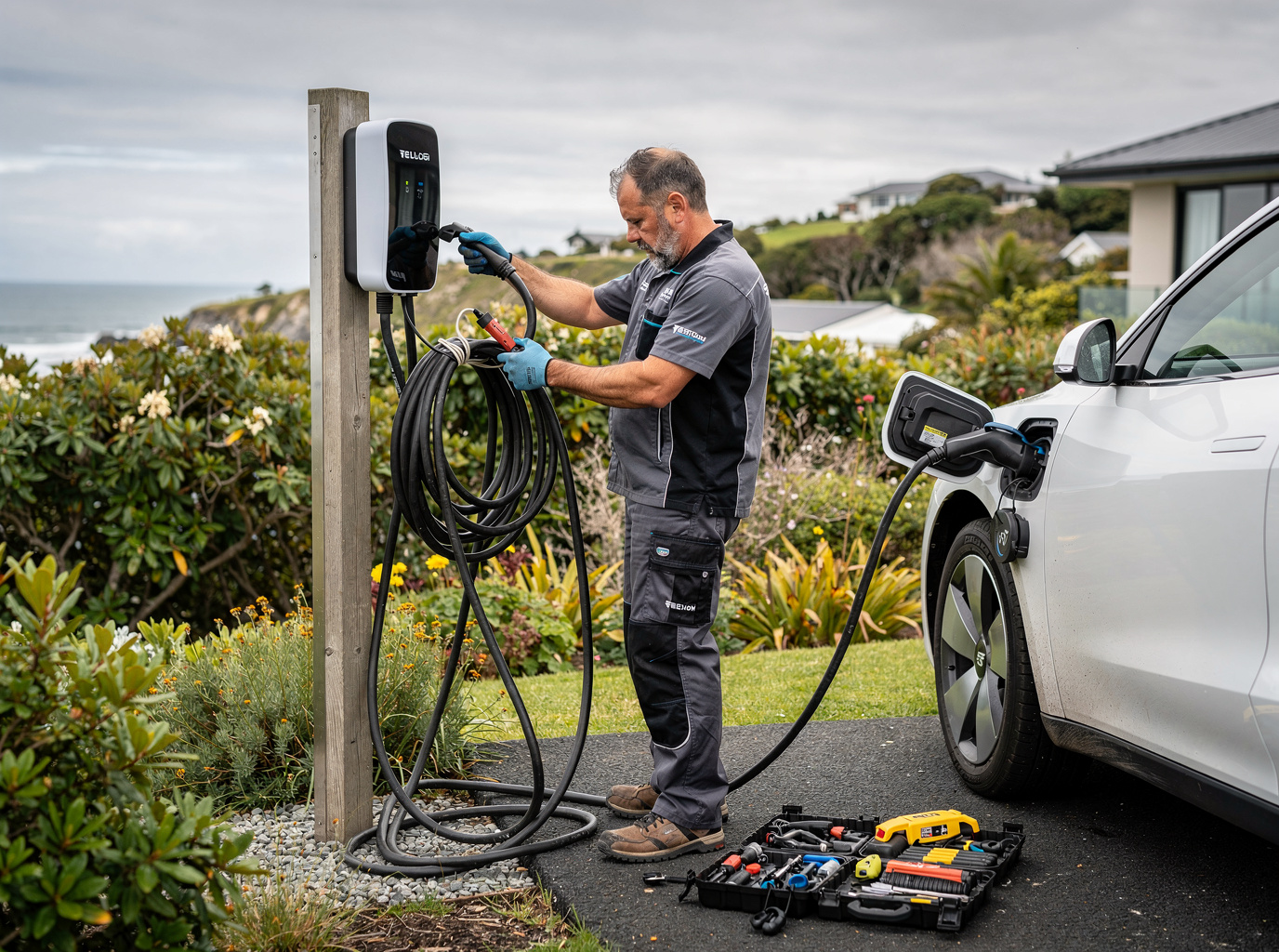
Dunedin homes built from the 1960s through the 1990s often have 100-amp or 150-amp panels that require careful load calculations before adding a Level 2 charger. Salt air drifting in from the Dunedin Causeway and Honeymoon Island accelerates corrosion on outdoor receptacles and conduit fittings, so we use marine-grade stainless hardware and dielectric grease on every exterior termination. Hot humid summers push ambient temperatures above 90 degrees for months, which raises the risk of thermal derating on chargers mounted in direct sun along the west-facing sides of homes in Downtown Dunedin.
Pinellas County permitting requires a separate electrical permit and inspection for any hardwired charger over 40 amps. We coordinate with the county building department and verify that the existing service entrance can support the added load without triggering an upgrade. In neighborhoods like Curlew Creek, underground feeder runs are common and frequently encounter water intrusion during summer storms, so we pressure-test conduits and install GFCI protection at the charger rather than relying solely on the breaker.
Nearby cities such as Clearwater and Palm Harbor share the same older aluminum wiring stock, which demands anti-oxidant compound and proper torque specs when landing new feeder conductors. We always verify neutral and ground separation at the subpanel serving the garage or carport to meet current code and avoid nuisance tripping on the charger’s internal GFCI.
Seasonal patterns matter here. Winter visitors from Safety Harbor and Palm Harbor often request faster charging for longer daily drives, while year-round residents need units that can sit idle through weeks of high humidity without moisture damage inside the enclosure.
Technician insight
In Dunedin the thing that catches most people out with EV Charger Repair and Installation is salt air from the causeway and Honeymoon Island corroding the neutral and ground terminations inside outdoor enclosures. Homes in Curlew Creek and older sections of Downtown Dunedin often have aluminum feeders that loosen over time in the heat and humidity, creating high-resistance points that trip the charger’s GFCI repeatedly.
Corroded Terminals On A Curlew Creek Charger
A homeowner in Curlew Creek reported repeated GFCI trips on their outdoor unit after summer storms. We found salt corrosion on the neutral lug inside the enclosure and oxidized aluminum feeder strands at the subpanel. We replaced the enclosure with marine-rated hardware, cleaned and torqued all connections with anti-oxidant, and added a new isolated ground conductor. The charger has operated without interruption through the following humid season.
EV Charger Repair and Installation Services We Offer
✓Level 2 Charger Installation
Hardwired 240-volt charger mounting with new circuit, conduit, and permit coordination for homes near Honeymoon Island and the causeway.
✓EV Charger Troubleshooting
Diagnosis of no-start, GFCI trips, or communication faults caused by corrosion from salt air or loose connections in older Dunedin panels.
✓Outdoor Charger Enclosure Upgrade
Replacement of weather-damaged enclosures and seals using marine-rated components to handle Pinellas County humidity and storm exposure.
✓Panel Load Calculation and Upgrade
Service assessment and subpanel addition when existing 100-amp or 150-amp panels in Curlew Creek homes cannot support charger demand.
✓Charger Relocation
Moving an existing unit to a new parking spot while updating wiring and protection to current code for properties near Downtown Dunedin.
EV Charger Repair and Installation Cost in Dunedin, FL
| Service | Typical Range | What Affects It |
|---|---|---|
| Level 2 Charger Installation | $900–$1,800 | Varies with panel capacity and run length in older Dunedin homes |
| Panel Upgrade For Charger | $1,600–$3,200 | Required when service is 100 or 150 amps |
| Charger Troubleshooting Visit | $150–$350 | Diagnostic fee credited toward repair |
| Outdoor Enclosure Replacement | $400–$750 | Marine-grade parts for causeway-area corrosion |
Ranges are typical for Dunedin, FL and confirmed with an exact written quote before any work starts.
How it works
- 1
Site Assessment
We inspect the panel, existing wiring, and mounting location while noting exposure to salt air and humidity near the causeway.
- 2
Load Calculation
We calculate available capacity and determine if a panel upgrade or subpanel is required before any work begins.
- 3
Permitting And Installation
We pull the Pinellas County permit, run new conduit and conductors, and mount the charger with proper grounding.
- 4
Testing And Inspection
We energize the unit, verify GFCI function, and schedule the county inspection for final approval.
Pricing
Upfront written quotes provided after the site visit during Mon–Fri 8am–6pm or Sat 9am–2pm.